The Analytical Engine Explained: How Babbage’s Machine Preceded the Modern Computer
Welcome to my blog theaihistory.blogspot.com, a comprehensive journey chronicling the evolution of Artificial Intelligence, where we will delve into the definitive timeline of AI that has reshaped our technological landscape. History is not just about the distant past; it is the foundation of our future. Here, we will explore the fascinating milestones of machine intelligence, tracing its roots back to the theoretical brilliance of early algorithms and Alan Turing's groundbreaking concepts that first challenged humanity to ask whether machines could think. As we trace decades of historical breakthroughs, computing's dark ages, and glorious renaissance, we will uncover how those early mathematical dreams paved the way for today's complex neural networks. Join us as we delve into this rich historical tapestry, culminating in the transformative modern era of Generative AI, to truly understand how this revolutionary technology has evolved from mere ideas to systems redefining the world we live in. Happy reading..
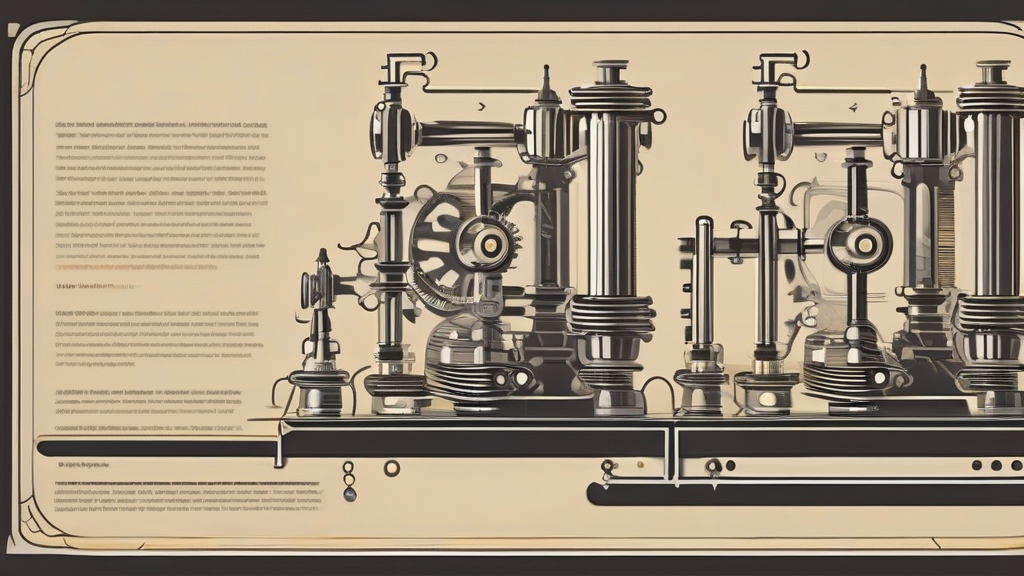
When I first stumbled upon the blueprints for Charles Babbage’s Analytical Engine, I felt like I was looking at a time machine. We often assume that the digital age arrived out of nowhere in the 1940s, but the conceptual heavy lifting was done over a century earlier. The story of Before Computers: Ada Lovelace and the 19th-Century Vision of AI is not just a footnote in history; it is the blueprint for our entire modern existence.
Most people imagine early inventors as dusty men in workshops, yet the intellectual partnership between Babbage and Lovelace was remarkably visionary. They weren't just building a calculator; they were dreaming of a machine that could manipulate symbols, compose music, and process logic. It is a fascinating realization that the seeds of our current silicon-driven world were planted in the era of steam and brass.
The Visionary Design: Understanding the Analytical Engine
Babbage was a man possessed by the idea of eliminating human error. He saw the Difference engine as a start, but the Analytical Engine was his true masterpiece. It was designed to be a general-purpose machine, capable of performing any mathematical operation given the right instructions.
The Architecture of 19th-Century Innovation
If you look at the architecture of his engine, you see the clear ancestors of our modern hardware. It featured a "mill" for processing data and a "store" for holding information—essentially the CPU and memory of today’s laptops. The input was handled via punched cards, a technology borrowed from the Jacquard loom, which meant the machine could be reprogrammed for different tasks.
Why did it fail to reach completion in his lifetime? Mostly, it was a matter of extreme precision and funding. The engineering tolerances required for thousands of brass gears and levers were simply beyond the manufacturing capabilities of the mid-1800s. Yet, the logic remained sound.
Before Computers: Ada Lovelace and the 19th-Century Vision of AI
Ada Lovelace brought a different kind of magic to the table. While Babbage focused on the mechanical nuts and bolts, Lovelace grasped the philosophical implications of the machine. She saw that numbers could represent things other than quantity—like musical notes or logical propositions.
The First Programmer’s Insight
Lovelace didn’t just write a program; she understood the potential for machine intelligence. She famously remarked that the engine had no pretension to originate anything; it could do whatever we knew how to order it to perform. This distinction is still the heart of the debate surrounding modern artificial intelligence.
She recognized that if a machine could process symbols based on rules, it could potentially simulate human cognition. This wasn't just a technical observation; it was a leap of faith into the unknown. She saw the Analytical Engine as a partner for human creativity rather than a mere counting device.
The Legacy of 19th-Century AI Concepts
When we talk about the history of computing, we often ignore the human element. The analytical engine was never just about cold, hard math. It was about the bridge between human intent and mechanical execution.
Think about how we interact with our own devices today. We feed them data, we provide algorithms, and we expect a result. That exact workflow was articulated by Lovelace in her notes on the engine. She effectively wrote the first algorithm intended to be carried out by a machine.
Why These Ideas Still Matter
The vision of AI from the 1800s remains relevant because it addresses the core "why" of technology. Why do we build these machines? To extend our reach, to organize our chaos, and to see patterns that our biological brains might miss. Babbage and Lovelace understood that the machine was only as good as the vision behind it.
- Input: Punched cards as the original software medium.
- Processing: The Mill as the precursor to the modern processor.
- Memory: The Store as the foundation for RAM and storage drives.
- Logic: The ability to handle conditional branching, or "if-then" statements.
Reframing the History of Computing
It is easy to get caught up in the speed of modern processors and forget that our logic is ancient. Every time you open an application, you are standing on the shoulders of these two Victorian pioneers. They didn't have electricity, yet they had the mental clarity to map out the future.
The Analytical Engine serves as a reminder that technology is a continuous thread. It doesn't start with a single breakthrough but with a long, slow accumulation of ideas. Babbage’s machine was the hardware dream, and Lovelace’s notes were the software reality.
Lessons for Modern Business Owners
What can a business owner today learn from a machine that was never finished? Plenty. First, that failure to launch doesn't mean the idea was wrong. Babbage’s engine was a failure of engineering, not of concept.
Second, the importance of documentation cannot be overstated. We only know the full potential of the Analytical Engine because of Lovelace’s meticulous notes. If she hadn't taken the time to translate and expand upon Babbage’s work, we might have lost this vision for another century.
Building Your Own Systems
When you build your own business systems, think like Babbage. Create a "mill" for your core operations and a "store" for your data. Ensure that your processes are repeatable and, most importantly, programmable. If you can’t describe your business process as a series of steps, you aren't ready to automate it.
The 19th-century vision of AI was about order. By applying that same level of rigor to your daily operations, you can achieve a level of efficiency that feels almost mechanical in its precision. Don't wait for the perfect tools; start with the logic you have today.
The Unfinished Dream
We live in a world where the Analytical Engine has effectively been built, dismantled, and rebuilt a million times over in silicon. We have surpassed the mechanical limitations that held Babbage back, but have we surpassed the vision of Lovelace?
She warned us about the limits of machines—that they can only do what we tell them. As we move toward more autonomous systems, that warning feels more prophetic than ever. We are still the architects, and the machines are still our tools.
Reflecting on this history provides a grounding perspective. It reminds us that technology is a human endeavor, shaped by our dreams, our limitations, and our relentless desire to solve the puzzles of the universe. The next time you find yourself frustrated by a software glitch or a slow upload, remember that we are playing with the same fundamental concepts that Babbage and Lovelace mapped out with nothing more than ink, paper, and sheer intellect.
If you want to master your own digital systems, start by understanding the logic behind them. Stop treating your tools as magic and start treating them as the sophisticated, rule-based engines they are. Take the time to map out your own "analytical engine" for your business, and you might be surprised at how much more you can accomplish. Start documenting your processes today—your future self will thank you for the clarity.
Thank you for reading my article carefully, thoroughly, and wisely. I hope you enjoyed it and that you are under the protection of Almighty God. Please leave a comment below.
Post a Comment for "The Analytical Engine Explained: How Babbage’s Machine Preceded the Modern Computer"