The Influence of Lord Byron on Ada Lovelace’s Mathematical Ambitions
Welcome to my blog theaihistory.blogspot.com, a comprehensive journey chronicling the evolution of Artificial Intelligence, where we will delve into the definitive timeline of AI that has reshaped our technological landscape. History is not just about the distant past; it is the foundation of our future. Here, we will explore the fascinating milestones of machine intelligence, tracing its roots back to the theoretical brilliance of early algorithms and Alan Turing's groundbreaking concepts that first challenged humanity to ask whether machines could think. As we trace decades of historical breakthroughs, computing's dark ages, and glorious renaissance, we will uncover how those early mathematical dreams paved the way for today's complex neural networks. Join us as we delve into this rich historical tapestry, culminating in the transformative modern era of Generative AI, to truly understand how this revolutionary technology has evolved from mere ideas to systems redefining the world we live in. Happy reading..
The Romantic Roots of Analytical Thought
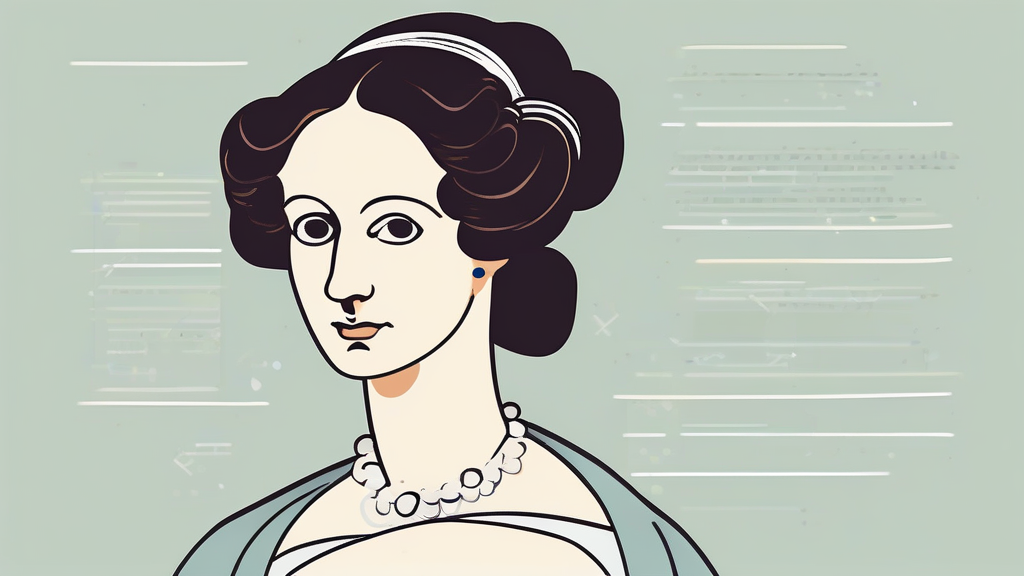
Most people know Ada Lovelace as the woman who saw a future where machines could do more than just crunch numbers. But to understand her brilliance, you have to look at the man she never really knew: her father, the infamous poet Lord Byron. It’s a strange juxtaposition, isn't it? The quintessential Romantic poet and the woman who laid the groundwork for modern computing.
Growing up, Ada’s mother, Lady Byron, was terrified that Ada would inherit the "Byronic" temperament—a volatile, moody, and overly imaginative nature. To counteract this, she steered Ada toward mathematics and logic with a fervor that bordered on the obsessive. She wanted to ground her daughter in the cold, hard facts of the universe.
Yet, the irony is that Ada didn't just become a mathematician; she became a "poetical scientist." She possessed a rare ability to bridge the gap between strict logic and creative intuition. This unique synthesis is what allowed her to dream of a world Before Computers: Ada Lovelace and the 19th-Century Vision of AI.
The Influence of Lord Byron on Ada Lovelace’s Mathematical Ambitions
Even though he left when she was an infant, Lord Byron’s shadow loomed large over Ada’s life. Her mother encouraged a rigorous education, but Ada’s own mind naturally gravitated toward the imaginative. She didn't see math as a series of dry, isolated equations. Instead, she viewed it as a language of patterns, much like the rhythm and meter in a poem.
Her father was a master of the written word, capable of painting vivid landscapes with just a few stanzas. Ada, in turn, used that same artistic flair to describe the potential of Charles Babbage’s Analytical Engine. Where others saw a mechanical calculator, she saw a machine that could manipulate symbols according to rules, potentially creating music or art.
Merging Imagination with Calculation
Ada’s mathematical ambitions were fueled by a desire to understand the hidden connections within the universe. She didn't want to just solve problems; she wanted to map out the possibilities of what machines could achieve. This was a radical departure from the standard scientific thought of the 1840s.
She often referred to her work as "poetical science." By treating numbers as metaphors for the physical world, she could envision the abstract capabilities of technology. It’s almost as if she took the emotional intensity of a Romantic poem and poured it into the rigid framework of algebraic notation.
Setting the Stage for Artificial Intelligence
When we look at the history of technology, we often focus on the hardware. We talk about gears, steam, and brass. But Ada Lovelace saw the software before anyone knew what software was. She realized that if a machine could follow a set of instructions, it could effectively "think" in a procedural sense.
This perspective is exactly why we discuss her work when we talk about the history of artificial intelligence. She was the first to articulate that a machine could process non-numerical information, provided that the data could be represented by symbols. It’s a concept that feels incredibly modern, even though it was written down nearly two centuries ago.
The Analytical Engine and the Logic of Creativity
Imagine being in 1843, looking at a device designed to calculate navigation tables, and concluding that it could write music. That’s what Ada did. She understood that if you could define the laws of harmony and pitch mathematically, the engine could be programmed to compose pieces of music of any degree of complexity.
This insight was truly ahead of its time. It moved beyond simple arithmetic and into the realm of symbolic logic. This is the cornerstone of what we now recognize as the foundational elements of artificial intelligence. She wasn't just building a calculator; she was building a concept for a universal machine.
Why Her Legacy Still Matters Today
Why do we still talk about her? It’s not just because she was a woman in a male-dominated field. It’s because she possessed a unique perspective on the intersection of human creativity and technical limitation. In a world currently obsessed with generative AI, her words provide a necessary anchor.
She famously noted that the Analytical Engine had no pretensions to originate anything; it could only do what we knew how to order it to perform. This distinction between human intent and machine execution is still the central debate in modern AI ethics. We are still grappling with the very boundaries she defined in her notes.
Lessons from the 19th Century
Ada teaches us that technical expertise is only half the battle. To truly push the boundaries of what is possible, you need the imagination to see where the technology can go. This is a lesson for every entrepreneur, engineer, and creative thinker today.
- Embrace Interdisciplinary Thinking: Don't silo your skills. The most interesting breakthroughs happen at the intersection of different fields.
- Focus on Symbolic Representation: Understanding how to translate complex ideas into clear, logical steps is the key to automation.
- Question the Status Quo: Just because a tool is built for one purpose doesn't mean it can't be adapted for another.
- Acknowledge the Human Element: No matter how advanced the machine, the "why" behind the code comes from human intent.
The Byronic Spirit in Modern Code
There is a poetic quality to modern programming that I think Ada would have loved. We write lines of code that dictate the behavior of complex systems, much like a poet chooses words to evoke a specific emotional response. The rhythm, the structure, and the logic all have to align perfectly for the program to function.
Ada’s father was known for his restless, searching spirit, always looking for the next horizon. Ada inherited that same drive. She wasn't content with the math of her day; she wanted to push it into the future. She applied that restless curiosity to the gears and levers of Babbage’s machines, and in doing so, she opened a door that we are still walking through today.
Reflecting on the Visionary
When I think about the challenges we face with technology today, I often find myself coming back to Ada. We get so caught up in the speed of updates and the power of new models that we forget to ask the fundamental questions. What are we building this for? What is the creative potential of this tool?
Ada Lovelace didn't have a screen, a keyboard, or a processor. She had a pen, a piece of paper, and an incredible ability to look at a machine and see a future that didn't exist yet. She reminds us that the most powerful tool you have isn't the software on your laptop—it’s your own mind.
Moving Forward with a Vision
The story of Ada Lovelace is more than just a historical footnote. It’s a roadmap for how to approach the unknown. Whether you’re running a business, writing code, or simply trying to navigate the complexities of our modern world, her example is worth following.
Don't be afraid to dream big. Don't be afraid to apply your passions to your professional work. If you can bridge the gap between your creative instincts and your logical goals, there’s no telling what you might build. Take a page from Ada's book and start looking at the world not just for what it is, but for what it could become.
If you want to understand the future, you have to appreciate the visionaries of the past. Start by learning more about the history of technology and how it shapes our present. Who knows? You might just find the inspiration you need to build the next big thing.
Thank you for reading my article carefully, thoroughly, and wisely. I hope you enjoyed it and that you are under the protection of Almighty God. Please leave a comment below.
Post a Comment for "The Influence of Lord Byron on Ada Lovelace’s Mathematical Ambitions"