Ada Lovelace’s Vision for 'Poetical Science': Bridging Art and Mathematics
Welcome to my blog theaihistory.blogspot.com, a comprehensive journey chronicling the evolution of Artificial Intelligence, where we will delve into the definitive timeline of AI that has reshaped our technological landscape. History is not just about the distant past; it is the foundation of our future. Here, we will explore the fascinating milestones of machine intelligence, tracing its roots back to the theoretical brilliance of early algorithms and Alan Turing's groundbreaking concepts that first challenged humanity to ask whether machines could think. As we trace decades of historical breakthroughs, computing's dark ages, and glorious renaissance, we will uncover how those early mathematical dreams paved the way for today's complex neural networks. Join us as we delve into this rich historical tapestry, culminating in the transformative modern era of Generative AI, to truly understand how this revolutionary technology has evolved from mere ideas to systems redefining the world we live in. Happy reading..
The Hidden Legacy of a Victorian Visionary
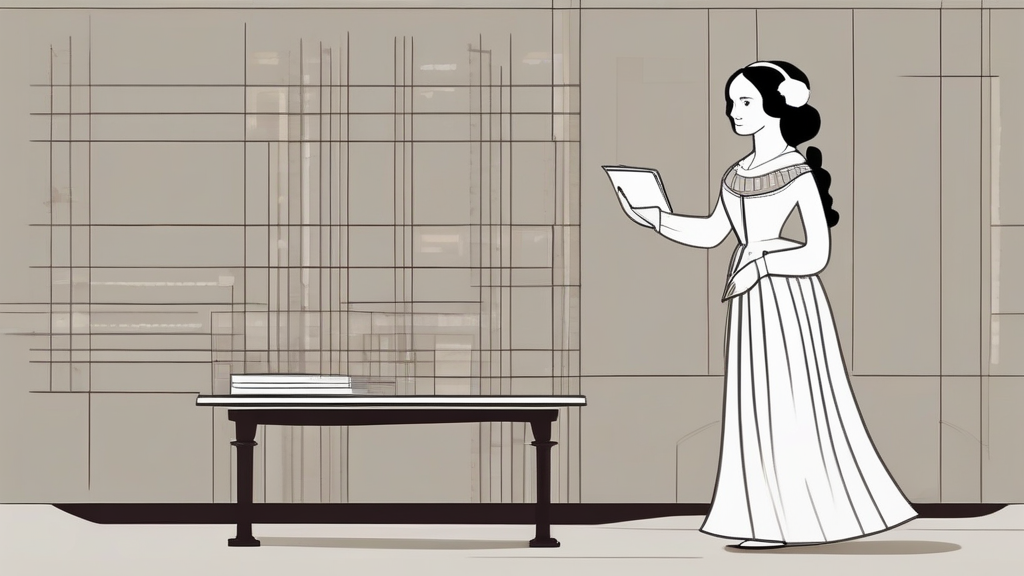
Most people assume that artificial intelligence is a modern invention birthed in Silicon Valley garages. They imagine lines of code flickering to life in the late 20th century. However, the roots of our current technological reality run much deeper, stretching back to the smoke-filled rooms of the Victorian era. Before computers: Ada Lovelace and the 19th-century vision of AI defined a path that blended the rigid logic of mathematics with the fluid creativity of the arts. She didn't just see numbers; she saw a language for the world. As I look at my own screen today, I often wonder if we have lost the spirit of her work. We treat software as a utility, yet Lovelace saw it as a medium for expression. She was a woman ahead of her time, operating in a society that rarely gave women a seat at the scientific table.Defining the Concept of Poetical Science
Lovelace didn't view science as a cold, sterile pursuit of data. She coined the term "Poetical Science" to describe her unique approach to the world. To her, imagination was the most important tool for any scientist or mathematician. Without the ability to visualize the unseen, we are merely counting beans. She believed that to truly understand the universe, one must be able to weave together the abstract and the tangible.The Intersection of Logic and Imagination
How does one bridge the gap between a poem and an algorithm? For Lovelace, the answer lay in the Analytical Engine designed by Charles Babbage. She realized that this machine could do more than just crunch numbers. If a machine could manipulate symbols according to rules, it could potentially manipulate music, art, or logic itself. She saw the potential for machines to create beauty. This was a radical departure from the mechanical view of her contemporaries. * Mathematics provides the structure. * Imagination provides the purpose. * Technology acts as the bridge. By merging these, she anticipated the computational power we rely on today. She wasn't just building a calculator; she was building a mirror for human thought.Before Computers: Ada Lovelace and the 19th-Century Vision of AI
When we discuss the history of technology, we often ignore the philosophical foundations laid in the 1800s. The idea that a machine could simulate intelligence—or at least follow complex instructions to produce creative output—was born from her notes. She recognized that the engine had no "intelligence" of its own. It could only do what we knew how to order it to do. This distinction is the bedrock of modern computer science.Why Her Perspective Matters to Business Owners
You might be wondering why a 19th-century mathematician matters to your modern business. The answer is simple: strategy. We are currently obsessed with the "how" of AI—how to prompt, how to automate, how to scale. Lovelace focused on the "why." She understood that tools are useless without a vision. When you approach your business, are you just automating tasks, or are you designing systems that reflect a deeper, more creative strategy? Those who succeed in the future won't just be the ones with the fastest AI. They will be the ones who understand how to apply human intuition to machine precision. That is the essence of her "Poetical Science."Breaking the Barriers of Tradition
Ada Lovelace lived in a time where women were expected to be ornamental. Her mother, Lady Byron, pushed her toward mathematics specifically to suppress the "madness" of her father, Lord Byron’s, poetic nature. The irony is delicious. By forcing her into math, they gave her the exact tools she needed to unleash her poetic mind. She didn't choose between art and science; she refused to let them be separated.Lessons for the Modern Innovator
We often feel the need to categorize ourselves. Are you a creative or a data analyst? Are you a writer or a programmer? Lovelace teaches us that these labels are artificial. * Embrace your contradictions. * Use your technical skills to amplify your creative voice. * Question the status quo of your industry. When you refuse to be put in a box, you find solutions that others miss. She saw a future where machines could compose music and create graphics, long before electricity was even a household staple.The Human Element in a Digital Age
As we move forward, the fear that machines will replace human creativity continues to grow. Yet, looking back at Lovelace’s work, we see that she never feared the machine. She empowered it. She saw the machine as a partner. It was a tool that allowed the human mind to soar higher by handling the tedious calculations that would otherwise bog us down. This is the perspective we need to adopt.Cultivating Your Own Poetical Science
How can you apply this today? Start by looking at your daily workflows. Are you using your tools to free up your mind for bigger ideas? 1. Identify the repetitive tasks in your day. 2. Find ways to delegate these to automated systems. 3. Invest that saved time into the "poetical" side of your work—strategy, storytelling, and design. If you aren't using your technology to create more space for human insight, you are falling behind. Lovelace didn't just document the engine; she dreamed of what it could become. You should be doing the same with your own business.Reflecting on a Legacy of Vision
The story of Ada Lovelace is not just a history lesson. It is a blueprint for how we should exist in a world dominated by algorithms. We need to be the poets of our own systems. We need to inject meaning into the metrics. We need to ensure that the logic driving our businesses serves a human purpose. If we do this, we honor the legacy of the woman who saw the future before the hardware even existed. The next time you feel overwhelmed by the rapid pace of change, remember that the foundation was built by someone who saw beauty in the math. You have the same capacity to blend your passions. What will you build? Will you settle for simple automation, or will you strive for a higher form of creation? The choice is yours, and the tools are already in your hands. Take a page from history and start thinking like a poet of science.Thank you for reading my article carefully, thoroughly, and wisely. I hope you enjoyed it and that you are under the protection of Almighty God. Please leave a comment below.
Post a Comment for "Ada Lovelace’s Vision for 'Poetical Science': Bridging Art and Mathematics"