From Dartmouth to Deep Learning: Tracing the 65-Year Legacy of AI's Founding Conference
Welcome to my blog theaihistory.blogspot.com, a comprehensive journey chronicling the evolution of Artificial Intelligence, where we will delve into the definitive timeline of AI that has reshaped our technological landscape. History is not just about the distant past; it is the foundation of our future. Here, we will explore the fascinating milestones of machine intelligence, tracing its roots back to the theoretical brilliance of early algorithms and Alan Turing's groundbreaking concepts that first challenged humanity to ask whether machines could think. As we trace decades of historical breakthroughs, computing's dark ages, and glorious renaissance, we will uncover how those early mathematical dreams paved the way for today's complex neural networks. Join us as we delve into this rich historical tapestry, culminating in the transformative modern era of Generative AI, to truly understand how this revolutionary technology has evolved from mere ideas to systems redefining the world we live in. Happy reading..
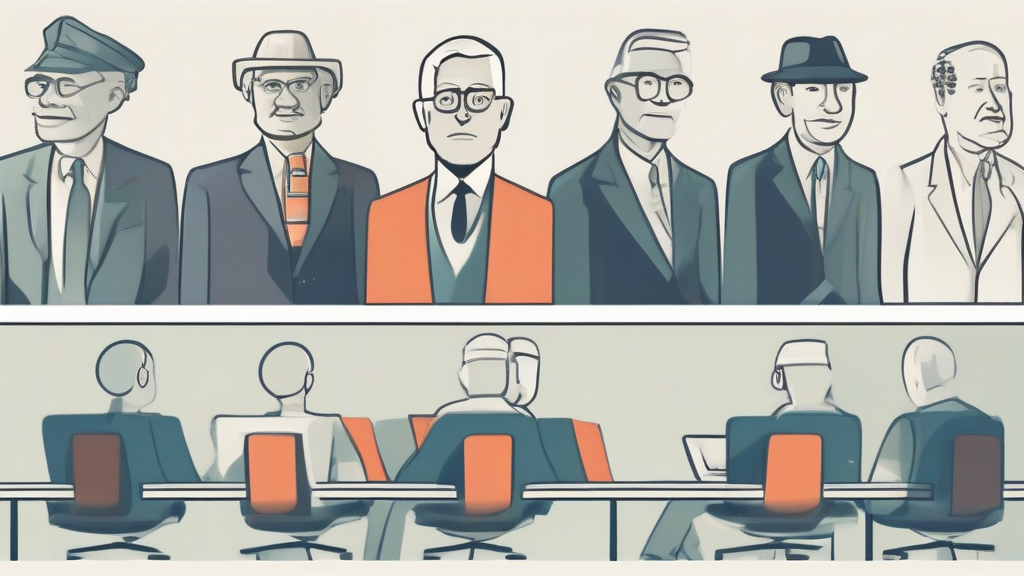
The Genesis of a Grand Vision: Remembering The Dartmouth Conference of 1956
Picture this: a sweltering summer in New Hampshire, 1956. A small, unassuming gathering of brilliant minds at Dartmouth College. Little did they know, they were about to etch their names into history, laying the groundwork for what would become one of humanity's most transformative endeavors. It was here, in the quiet halls of academia, that what many consider to be The Dartmouth Conference of 1956: The True Birthplace of Artificial Intelligence, unfolded.
For decades, I've been fascinated by the origins of ideas that shape our world. And when we talk about artificial intelligence, its roots aren't some mystical Silicon Valley moment, but a meticulously planned, albeit somewhat informal, academic workshop. This wasn't just another conference; it was a crucible where the very term "Artificial Intelligence" was coined, and where the ambitious dream of creating intelligent machines truly began to take shape.
We often hear about AI in the context of self-driving cars, personalized recommendations, or even sophisticated chatbots. But to truly appreciate where we are, we must look back at where it all started. It’s a story of audacious ambition, collaborative spirit, and a touch of scientific foresight that still resonates today, over six decades later.
A Summer of Thought: The Proposal That Started It All
The story really begins a year prior, in 1955. A young, visionary computer scientist named John McCarthy, then at Dartmouth, teamed up with Marvin Minsky, Nathaniel Rochester, and Claude Shannon to draft a proposal. This wasn't just any proposal; it was a call to action, an invitation to explore the very nature of thought and computation.
Their premise was bold: "We propose that a 2 month, 10 man study of artificial intelligence be carried out during the summer of 1956 at Dartmouth College in Hanover, New Hampshire." They believed that "every aspect of learning or any other feature of intelligence can in principle be so precisely described that a machine can be made to simulate it." Talk about setting a high bar!
The goal was clear: to explore how machines could be made to use language, form abstractions and concepts, solve problems reserved for humans, and even improve themselves. It was an incredibly optimistic outlook, one that perhaps underestimated the sheer complexity of human cognition, but nonetheless ignited a passion that would fuel generations of researchers.
The Minds Behind the Machine: Key Players and Their Contributions
The conference, though slated for ten men over two months, ended up being a more fluid affair, with various participants coming and going throughout that summer. Yet, the core group and their ideas formed an undeniable bedrock for the field.
Let’s meet some of the intellectual giants who converged at Dartmouth:
- John McCarthy: The principal organizer and the individual credited with coining the term Artificial intelligence. His vision for symbolic AI and his later work on LISP would be foundational.
- Marvin Minsky: A brilliant polymath whose work on neural networks and later, his Society of Mind theory, profoundly influenced AI research. He brought an interdisciplinary perspective, blending psychology with computer science.
- Allen Newell and Herbert A. Simon: These two researchers from Carnegie Mellon University were already making waves with their "Logic Theorist" program. They arrived at Dartmouth with a working AI program, demonstrating the potential of symbolic reasoning.
- Nathaniel Rochester: An IBM researcher who had already contributed significantly to early computer design. His practical experience with hardware was invaluable.
- Claude Shannon: Often called "the father of information theory," Shannon's presence lent immense theoretical weight to the proceedings. His insights into communication and computation were critical.
These weren't just academics; they were pioneers, each bringing a unique piece to the puzzle. Their discussions weren't just theoretical; they were actively trying to build the future, right there and then.
Early Ambitions and the Logic Theorist
One of the most concrete achievements brought to the conference was the Logic Theorist program, developed by Newell, Simon, and J.C. Shaw. This program was capable of proving theorems from Russell and Whitehead's Principia Mathematica. It wasn't just crunching numbers; it was performing a task that required logical reasoning, a hallmark of human intelligence.
I can only imagine the excitement in the room when they demonstrated this. Here was a machine, not just calculating, but thinking in a rudimentary way. It was a powerful proof of concept for the symbolic approach to AI, suggesting that intelligence could be modeled through rules and representations.
This early success, however, also set a precedent for over-optimism. The participants, buoyed by their initial breakthroughs, genuinely believed that general artificial intelligence was just around the corner. Simon famously predicted that "machines will be capable, within twenty years, of doing any work a man can do." A bold claim, indeed, and one that history would prove a tad premature.
The Legacy of The Dartmouth Conference of 1956: The True Birthplace of Artificial Intelligence
While the conference itself didn't produce a single, unified theory of AI, its impact was profound and far-reaching. It legitimized the field, gave it a name, and attracted significant funding and talent. It was the moment AI stopped being a fringe idea and became a recognized scientific discipline.
The seeds planted that summer led to several distinct research paradigms:
- Symbolic AI (Good Old-Fashioned AI - GOFAI): This approach, heavily influenced by McCarthy, Newell, and Simon, focused on representing knowledge using symbols and rules. Expert systems and logic programming emerged from this tradition.
- Connectionism (Neural Networks): Minsky, despite his later criticisms, contributed to early work on neural networks, exploring how intelligence could arise from interconnected nodes inspired by the brain.
- Search and Problem Solving: The conference highlighted the importance of search algorithms and heuristic methods for problem-solving, a core component of many AI systems even today.
It's fascinating to see how these divergent paths, born from the same initial discussions, would ebb and flow in prominence over the decades. Sometimes one approach dominated, sometimes another. This intellectual dynamism is a direct descendant of those intense summer debates.
The AI Winters and the Quest for General Intelligence
Of course, the path from Dartmouth to deep learning wasn't a straight line. The initial optimism of the 1950s and 60s led to inflated expectations, which eventually crashed into the harsh realities of computational limitations and the sheer difficulty of modeling human intelligence. This period saw the first "AI winter," a time of reduced funding and skepticism.
Researchers struggled with common sense reasoning, scalability, and the "frame problem" – how to represent and update a world model without explicitly listing every possible change. These were deeply philosophical and practical challenges that proved far more complex than anticipated.
Despite these setbacks, the core ambition to create truly intelligent machines never truly died. It simply went underground, nurtured by dedicated researchers who continued to chip away at the problems, often with limited resources. They believed in the dream, even when the public and funding agencies had lost faith.
From Symbolic Logic to Statistical Learning: A Paradigm Shift
For many years, symbolic AI, with its focus on explicit rules and knowledge representation, held sway. Think of expert systems that could diagnose diseases or configure computer systems by following a set of "if-then" rules. These systems were powerful within narrow domains but struggled with ambiguity, learning, and adapting to new situations.
Then, slowly but surely, a new paradigm began to gain traction: statistical learning. This approach, which had its own lineage stretching back to early work on neural networks and pattern recognition, moved away from hand-coded rules towards systems that could learn from data. It was a subtle shift at first, but one that would ultimately redefine the field.
The availability of vast datasets and increasingly powerful computing resources in the late 20th and early 21st centuries provided the perfect storm for this shift. Suddenly, machines could find patterns in data that humans might miss, leading to breakthroughs in areas like speech recognition and computer vision.
The Rise of Deep Learning: A Modern Echo of Early Connectionism
Fast forward to today, and we are witnessing an unprecedented surge in AI capabilities, largely driven by deep learning. This isn't some entirely new concept; it's a sophisticated evolution of those early connectionist ideas, particularly neural networks, that Marvin Minsky and others were exploring back at Dartmouth.
Deep learning models, with their multiple layers of interconnected "neurons," are incredibly good at learning hierarchical representations from raw data. They can identify objects in images, understand spoken language, and even generate creative content. It’s a remarkable testament to the enduring power of ideas, even those that lay dormant for decades.
When I see the incredible feats of systems like large language models, I can't help but think about those visionary scientists in 1956. They dreamed of machines that could use language and form concepts. Today, we're seeing those dreams manifest in ways that might have seemed like science fiction even a few years ago.
The Enduring Questions: What Does It Mean to Be Intelligent?
Despite all the progress, the core questions posed at The Dartmouth Conference of 1956: The True Birthplace of Artificial Intelligence, remain strikingly relevant. What exactly is intelligence? Can a machine truly think, or is it merely simulating thought? Are we building tools, or are we creating a new form of life?
These aren't just academic musings anymore. As AI becomes more integrated into our daily lives, these questions have profound ethical, social, and economic implications. Business owners are grappling with how to leverage AI ethically, and individuals are wondering about its impact on jobs and society.
The original Dartmouth proposal highlighted the challenge of getting machines to "improve themselves." This concept of machine learning and self-improvement is at the heart of modern AI. The ability of deep learning models to learn and adapt with minimal human intervention is both awe-inspiring and, for some, a little unsettling.
Looking Back, Looking Forward: The Next 65 Years
As we trace the 65-year legacy from Dartmouth to the cutting edge of deep learning, it's clear that the journey is far from over. The initial optimism, the subsequent winters, and the current resurgence all form part of a dynamic narrative. What will the next 65 years hold?
Will we achieve Artificial General Intelligence (AGI), the kind of broad, human-level intelligence that the Dartmouth pioneers envisioned? Or will AI continue to excel in specialized domains, becoming ever more powerful but still fundamentally different from human thought?
One thing is for sure: the spirit of inquiry, the audacious ambition to understand and replicate intelligence, first ignited at Dartmouth, continues to burn brightly. It’s a testament to the power of a small group of thinkers coming together, daring to ask "what if?"
So, the next time you interact with an AI-powered system, take a moment to reflect on its long and fascinating history. Remember those summer days in New Hampshire, where a handful of brilliant minds dared to dream of intelligent machines. Their legacy is all around us, shaping our present and undeniably charting our future.
The story of AI is not just about algorithms and data; it's a human story of curiosity, perseverance, and an unyielding quest to push the boundaries of what's possible. And it all began, quite definitively, with that pivotal gathering at Dartmouth.
Thank you for reading my article carefully, thoroughly, and wisely. I hope you enjoyed it and that you are under the protection of Almighty God. Please leave a comment below.
Post a Comment for "From Dartmouth to Deep Learning: Tracing the 65-Year Legacy of AI's Founding Conference"