The Evolution of Human-Computer Interaction: From Turing to GPT-4
Welcome to my blog theaihistory.blogspot.com, a comprehensive journey chronicling the evolution of Artificial Intelligence, where we will delve into the definitive timeline of AI that has reshaped our technological landscape. History is not just about the distant past; it is the foundation of our future. Here, we will explore the fascinating milestones of machine intelligence, tracing its roots back to the theoretical brilliance of early algorithms and Alan Turing's groundbreaking concepts that first challenged humanity to ask whether machines could think. As we trace decades of historical breakthroughs, computing's dark ages, and glorious renaissance, we will uncover how those early mathematical dreams paved the way for today's complex neural networks. Join us as we delve into this rich historical tapestry, culminating in the transformative modern era of Generative AI, to truly understand how this revolutionary technology has evolved from mere ideas to systems redefining the world we live in. Happy reading..
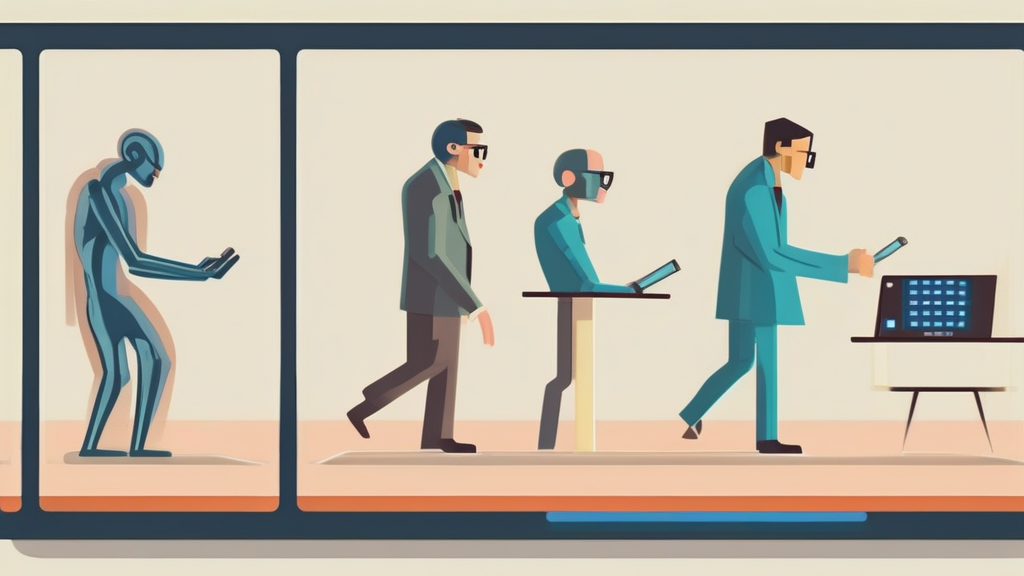
I remember sitting in a dimly lit computer lab back in college, staring at a green-text terminal. We were trying to build a simple chatbot that could hold a conversation for more than thirty seconds without breaking character. It felt like magic, yet it was painfully obvious the machine had no idea what it was saying. This experience sparked my lifelong fascination with how we talk to computers.
When we look at the trajectory of our relationship with machines, it is hard to ignore the shadow of Alan Turing. To understand where we are today with advanced models, we have to look back at the foundation. The Turing Test Explained: A 70-Year History of AI’s Most Famous Benchmark serves as the perfect lens through which to view our progress from simple logic gates to the nuanced, often eerie, capabilities of GPT-4.
The Origins of Machine Intelligence
Back in 1950, Alan Turing published a landmark paper that changed everything. He didn't just ask if machines could think; he proposed a practical way to measure it. He called it the "Imitation Game."
The core idea was simple: if a human judge cannot reliably distinguish between a human and a machine in a text-based conversation, the machine has effectively demonstrated intelligence. It shifted the goalposts from abstract philosophy to something we could actually test.
The Turing Test Explained: A 70-Year History of AI’s Most Famous Benchmark
For decades, this benchmark acted as the North Star for researchers. It wasn't perfect, but it gave us a common language. It forced us to define what we mean by "thinking."
Throughout the 1960s and 70s, programs like ELIZA made a splash by mirroring the user's own words back to them. People were genuinely fooled. They projected human emotions onto a script that was little more than a set of clever string-matching rules.
We have to remember that this wasn't true intelligence. It was a parlor trick. Yet, it proved that humans are inherently wired to find meaning in patterns, even when those patterns are entirely synthetic.
From Symbolic Logic to Neural Networks
For a long time, the dominant approach to AI was "good old-fashioned" symbolic logic. We tried to teach computers the rules of the world. We gave them dictionaries, grammar books, and logical operators.
If you wanted a computer to understand a sentence, you had to program every possible edge case. It was brittle. It was exhausting. And frankly, it rarely worked outside of a controlled, narrow environment.
Then came the shift toward artificial neural networks. Instead of telling the computer the rules, we started showing it examples. We let it figure out the patterns on its own.
The Statistical Turn
This approach changed the game. Instead of hard-coded logic, we began feeding machines vast amounts of text. The computer didn't "understand" the concept of a cat, but it knew that the word "cat" appeared frequently near the word "purr."
This statistical probability is the backbone of what we see in modern systems. It’s not thinking in the way a human does; it’s predicting the next piece of data based on a massive history of human-generated content.
The Turing Test, while historically significant, started to feel a bit outdated. A machine could pass by being a good mimic, without possessing any genuine reasoning or understanding of the world.
The Era of Large Language Models
Fast forward to the present day. We have moved past simple chatbots into the era of Large Language Models (LLMs). These systems are trained on datasets so large that they cover almost every corner of the internet.
When you interact with a system like GPT-4, you aren't just talking to a script. You are interacting with a model that has internalized the structures, biases, and creative flourishes of human language itself.
It can write poetry, debug code, and summarize legal documents. It feels like the science fiction stories I read as a kid are finally coming to life. But we have to be careful with our terminology.
Is the Benchmark Still Relevant?
If a machine can write a compelling essay or pass a bar exam, does it pass the Turing Test? Most people would say yes. But does it actually "know" anything?
The reality is that these models are still effectively stochastic parrots. They are incredibly sophisticated at predicting the next word, but they lack a grounded experience of reality.
- They don't have bodies to interact with the world.
- They don't have personal histories or memories of growing up.
- They don't have the capacity to feel pain, joy, or curiosity.
Despite these limitations, the utility is undeniable. As business owners and professionals, we aren't looking for a "conscious" machine; we are looking for a tool that can amplify our own capabilities. The shift from "can it think?" to "can it help?" is where the real value lies.
The Future of Human-Computer Interaction
We are entering a phase where the interface is disappearing. We used to use punch cards. Then we used command lines. Then we used mice and graphical user interfaces. Now, we use natural language.
This is the ultimate goal of human-computer interaction. When you can talk to your computer as naturally as you talk to a colleague, the barrier between intent and execution vanishes.
Think about the implications for your own workflow. You no longer need to learn the specific syntax of a complex software suite. You just describe what you want, and the machine provides the output.
Practical Applications for Business
If you are running an online business, this is the time to experiment. Don't wait for the technology to be perfect. Use these tools to handle the heavy lifting of:
- Drafting initial content outlines.
- Analyzing large sets of customer feedback.
- Automating routine email responses.
- Brainstorming marketing campaigns.
The key is to maintain a human-in-the-loop approach. Use the machine for the heavy lifting, but provide the final polish. Your brand voice, your unique perspective, and your strategic decision-making are still your most valuable assets.
Reflecting on the Benchmark
Looking back at the seventy-year history of the Turing Test, it's clear that our obsession with "passing" it was a reflection of our own insecurities. We wanted to build something that validated our own intelligence.
We’ve succeeded in building tools that can mimic us, but we’ve also discovered that human intelligence is about much more than just verbal dexterity. It’s about context, empathy, and the ability to navigate a world that isn't always logical.
The Turing Test explained: a 70-year history of AI’s most famous benchmark, shows us that we have come a long way. But it also shows us that the road ahead is wide open. We aren't just building smarter machines; we are redefining what it means to work alongside them.
Are you ready to integrate these tools into your daily routine? Start small. Ask your AI to draft a simple memo or summarize a long article. See how it changes your process. The future isn't about replacing human effort; it's about shifting our focus toward the tasks that only we can truly master.
The technology is here, and it is moving fast. Don't get left behind by worrying too much about the "thinking" aspect. Focus on the output, focus on the utility, and keep pushing the boundaries of what you can achieve with these powerful new partners by your side.
Thank you for reading my article carefully, thoroughly, and wisely. I hope you enjoyed it and that you are under the protection of Almighty God. Please leave a comment below.
Post a Comment for "The Evolution of Human-Computer Interaction: From Turing to GPT-4"