Understanding the Imitation Game: Alan Turing’s Original 1950 Vision
Welcome to my blog theaihistory.blogspot.com, a comprehensive journey chronicling the evolution of Artificial Intelligence, where we will delve into the definitive timeline of AI that has reshaped our technological landscape. History is not just about the distant past; it is the foundation of our future. Here, we will explore the fascinating milestones of machine intelligence, tracing its roots back to the theoretical brilliance of early algorithms and Alan Turing's groundbreaking concepts that first challenged humanity to ask whether machines could think. As we trace decades of historical breakthroughs, computing's dark ages, and glorious renaissance, we will uncover how those early mathematical dreams paved the way for today's complex neural networks. Join us as we delve into this rich historical tapestry, culminating in the transformative modern era of Generative AI, to truly understand how this revolutionary technology has evolved from mere ideas to systems redefining the world we live in. Happy reading..
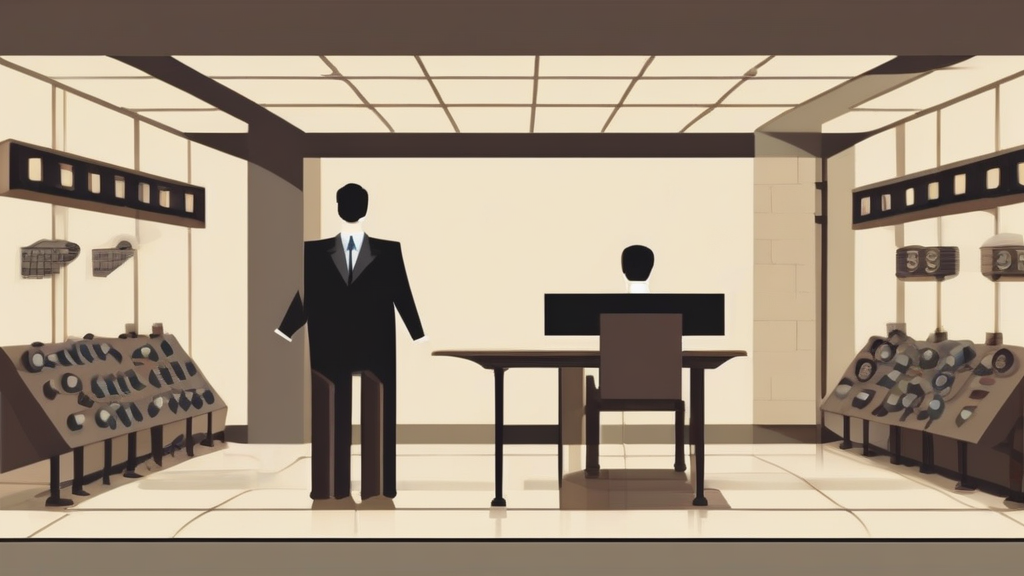
Back in 1950, a brilliant mathematician sat down to ask a question that would haunt computer science for decades: "Can machines think?" At the time, computers were room-sized monstrosities that performed simple calculations, yet Alan Turing saw something else entirely. He proposed an experiment, originally called the Imitation Game, which fundamentally shifted how we define intelligence.
Today, we live in an era where chatbots write code and generate art in seconds. Yet, understanding The Turing Test Explained: A 70-Year History of AI’s Most Famous Benchmark remains vital for anyone trying to grasp where we are heading. It is the yardstick by which we measure the distance between human cognition and silicon logic.
The Origins of the Imitation Game
Turing didn’t start by defining "thinking." He knew that defining the human mind was a philosopher’s trap. Instead, he proposed a practical test. Imagine a human judge sitting in a room, communicating via text with two hidden entities: one is a person, and the other is a machine.
If the judge cannot reliably tell which is which after a set period, the machine passes. It isn't about whether the machine understands the meaning of life or feels love. It is about whether the machine can mimic human conversation so convincingly that it fools us. This shift from "thinking" to "imitating" was a stroke of genius.
Why the 1950 Vision Still Matters
Turing was writing at a time when the Universal Turing machine was still a theoretical concept. He wasn't just predicting the future; he was laying the blueprint for it. He argued that if a machine could successfully imitate a human in a blind test, we should treat it as intelligent.
This perspective forces us to confront our own biases. We tend to grant "intelligence" to things that speak like us. When a computer provides a witty comeback or a nuanced explanation, we naturally assume there is a "ghost in the machine." Turing knew this human tendency would be the ultimate hurdle for AI.
The Turing Test Explained: A 70-Year History of AI’s Most Famous Benchmark
Over the last seven decades, the goalpost has moved constantly. In the 1960s, a program called ELIZA tricked users into thinking it was a psychotherapist simply by parroting their own questions back to them. It was a crude trick, but it worked. People grew attached to the machine, revealing more about human psychology than machine intelligence.
As we moved into the 21st century, the test became a benchmark for developers. Competitions like the Loebner Prize sought to find the first machine to truly pass the test. Yet, many experts argued that the test was becoming obsolete. Does passing a conversation test really mean a machine is "intelligent"?
The Problem with Mimicry
Mimicry isn't the same as understanding. A parrot can learn to say "hello" without knowing what a greeting is. Modern Large Language Models operate on similar principles, predicting the next likely word in a sequence based on massive datasets. They are masters of the Imitation Game, yet they lack consciousness.
Is this a failure of the test or a success of the technology? If we define intelligence as the ability to perform tasks that require human cognition, then these models are undeniably intelligent. If we define it as the presence of subjective experience, the test misses the mark entirely.
Beyond the Conversation: The Modern AI Landscape
Business owners often ask me if they should use these benchmarks to judge the software they buy. My answer is usually a cautious "no." The test was a philosophical thought experiment, not a practical evaluation for enterprise AI. You don't need a chatbot to be a philosopher; you need it to be accurate, helpful, and secure.
We are currently witnessing a shift toward Artificial General Intelligence. This is the hypothetical point where a machine can perform any intellectual task a human can. The original 1950 vision was the first step toward this goal, but the finish line looks very different than what Turing imagined.
Why We Still Talk About Turing
Even if the test is flawed, it serves as a necessary provocation. It forces us to define what makes us human. When a machine writes a poem, we feel a strange sense of unease. Why? Because we feel that creativity is our domain. Turing’s test strips away the pretension and asks us to prove that we are unique.
- It challenges our ego as the sole possessors of intelligence.
- It provides a quantifiable metric for progress in natural language processing.
- It keeps the focus on the user experience—the interaction between human and machine.
The Future of Machine Intelligence
Where does this leave us? We are past the point where the Imitation Game is the only metric that matters. Today, we test AI on its ability to solve complex math problems, write functional code, and analyze vast amounts of data. The "human-like" quality is now just one feature among many.
However, the core of Turing's 1950 vision remains relevant. As we integrate these tools into our businesses and daily lives, we are still playing the game. We are still the judges, and the machines are still trying to bridge the gap. The question is no longer whether they can fool us, but whether we can use them to enhance our own capabilities.
Final Thoughts on the Benchmark
Looking back at the history of this benchmark, I find it fascinating how little the core question has changed. We are still searching for that spark of true understanding. Perhaps we never will, or perhaps we will redefine intelligence so completely that the old benchmarks become mere historical footnotes.
Whether you are an entrepreneur looking to leverage AI or a curious observer of technological trends, remember that the technology is only as good as the questions we ask it. Turing gave us the framework; it is up to us to decide what we want these machines to become. Don't just settle for machines that imitate—seek out tools that augment your own unique, human perspective.
Are you ready to stop worrying about whether the machine is "thinking" and start focusing on how it can work for you? The best way to understand AI is to stop treating it like a magic trick and start treating it like a tool. Start experimenting with these systems today, push their boundaries, and see where they break. That is the only way to truly master the new age of intelligence.
Thank you for reading my article carefully, thoroughly, and wisely. I hope you enjoyed it and that you are under the protection of Almighty God. Please leave a comment below.
Post a Comment for "Understanding the Imitation Game: Alan Turing’s Original 1950 Vision"