5 Psychological Triggers That Caused Kasparov’s 1997 Collapse
Welcome to my blog theaihistory.blogspot.com, a comprehensive journey chronicling the evolution of Artificial Intelligence, where we will delve into the definitive timeline of AI that has reshaped our technological landscape. History is not just about the distant past; it is the foundation of our future. Here, we will explore the fascinating milestones of machine intelligence, tracing its roots back to the theoretical brilliance of early algorithms and Alan Turing's groundbreaking concepts that first challenged humanity to ask whether machines could think. As we trace decades of historical breakthroughs, computing's dark ages, and glorious renaissance, we will uncover how those early mathematical dreams paved the way for today's complex neural networks. Join us as we delve into this rich historical tapestry, culminating in the transformative modern era of Generative AI, to truly understand how this revolutionary technology has evolved from mere ideas to systems redefining the world we live in. Happy reading..
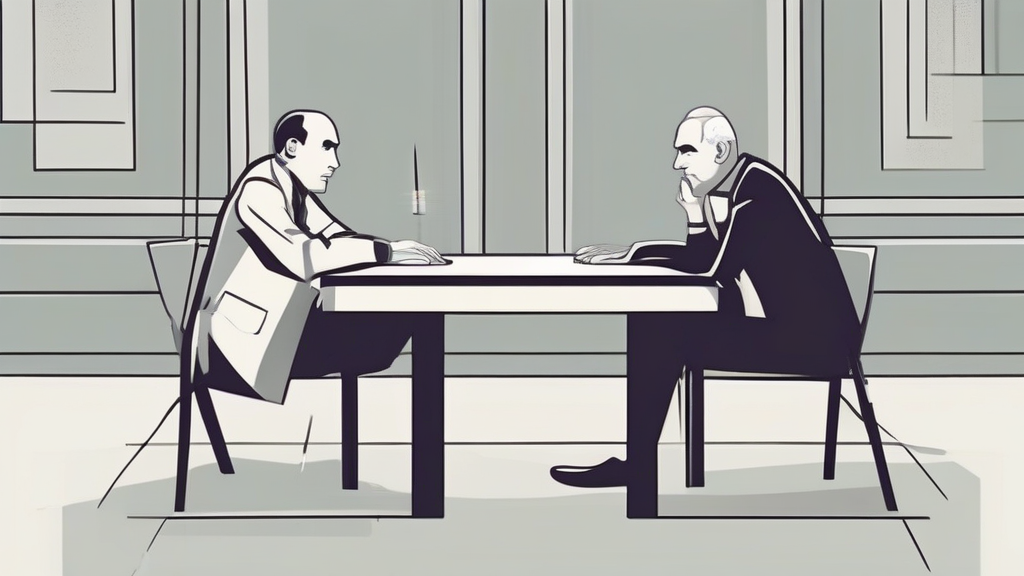
Analyzing the Garry Kasparov psychological state 1997 reveals how even the world's most formidable intellect can fray under the pressure of an unfamiliar opponent. Watching the greatest player in history crumble against a machine wasn't just a technical defeat; it was a breakdown of human intuition facing a cold, silicon wall.
Key Insights
- IBM's Deep Blue utilized brute-force processing that bypassed traditional human pattern recognition.
- Kasparov suffered from decision fatigue after the machine refused to play with recognizable human intent.
- The lack of a human physical "tell" created an information vacuum, fueling paranoia.
- External pressures, including IBM's corporate branding, amplified the stakes of the match.
- The final game collapse was a byproduct of prolonged cognitive dissonance.
Deconstructing the Garry Kasparov psychological state 1997
When you strip away the wires, the match was a masterclass in how uncertainty breeds failure. Kasparov was used to reading opponents, gauging their nervousness, and anticipating moves based on character. When that reflection disappeared, his internal compass spun wildly. The machine wasn't "thinking" in the human sense, but to Kasparov, it felt like an entity. This is the "uncanny valley" of decision-making. If you cannot predict your rival's next step because their logic is alien, you stop being a strategist and start being a target.| Trigger | Psychological Impact |
|---|---|
| Alien Logic | Disruption of human pattern recognition. |
| Lack of "Tells" | Increased paranoia and anxiety. |
| Corporate Stakes | Heightened pressure to defend human superiority. |
| Decision Fatigue | Degradation of analytical accuracy over 6 games. |
1. The Loss of the "Human Mirror"
Chess at the grandmaster level is a conversation. You play a move, you see the opponent wince, you adjust. Against Deep Blue, Kasparov was shouting into a void. Without a human face to read, his brain began hallucinating intent where there was only code. He projected his own fears onto the machine's inscrutable calculations. This is exactly what happens when a CEO faces a market disruption they don't understand; they start fighting ghosts instead of facts.2. Cognitive Dissonance and Paranoia
Kasparov became convinced that IBM was using human grandmasters to assist the machine during breaks. Whether true or not, the belief itself was the poison. Once he stopped trusting the integrity of the match, his focus shifted from the board to the periphery. He stopped playing chess and started playing "detective." You cannot win a game of precision while you are distracted by a hunt for conspiracies.3. The Trap of Expected Complexity
In the second game, Deep Blue played a move that looked erratic. To a human, a strange move signals a blunder or a genius trap. Kasparov assumed the latter. He spent excessive time trying to decode a "hidden" strategy that didn't exist. He treated a random glitch as a stroke of brilliance. By overthinking the simple, he bypassed the optimal path.4. The Burden of the Human Champion
He wasn't just playing for a trophy; he was playing for the species. The media narrative turned the match into a man vs. machine showdown. That weight is heavy. When you carry the expectations of billions, your margin for error shrinks. Any minor mistake feels like a catastrophe, which leads to tighter, more tentative play.5. Total Ego Collapse
By the sixth game, the damage was done. The psychological wall had been breached. The final resignation wasn't due to a bad position alone; it was a surrender of the spirit. He had lost his confidence in the one thing that defined him: his ability to out-think the world. Once that foundation cracked, the performance followed.Which AI defeated Garry Kasparov in 1997?
The machine was Deep Blue, a custom-built supercomputer developed by IBM. It was designed specifically for heavy-duty search algorithms and massive parallel processing.What was the significance of IBM's Deep Blue in 1997?
It marked the first time a reigning world champion lost a match to a computer under tournament conditions. It proved that brute-force computation could eventually outperform human intuition.Is "Rematch" a true story?
The 2020 documentary The Rematch covers the 1997 encounter accurately through interviews and archival footage. It captures the tension, the accusations, and the lasting impact on the chess community. Your greatest successes often rely on your ability to read the room. But when the room changes—when the rules, the stakes, and the opponent shift—you must remain anchored in your own process. Do not let the mystery of a new challenge distort your reality. Stop, recalibrate, and play the board, not the ghost.Thank you for reading my article carefully, thoroughly, and wisely. I hope you enjoyed it and that you are under the protection of Almighty God. Please leave a comment below.
Post a Comment for "5 Psychological Triggers That Caused Kasparov’s 1997 Collapse"