ELIZA vs. Modern LLMs: Comparing 1960s Rule-Based Logic to ChatGPT
Welcome to my blog theaihistory.blogspot.com, a comprehensive journey chronicling the evolution of Artificial Intelligence, where we will delve into the definitive timeline of AI that has reshaped our technological landscape. History is not just about the distant past; it is the foundation of our future. Here, we will explore the fascinating milestones of machine intelligence, tracing its roots back to the theoretical brilliance of early algorithms and Alan Turing's groundbreaking concepts that first challenged humanity to ask whether machines could think. As we trace decades of historical breakthroughs, computing's dark ages, and glorious renaissance, we will uncover how those early mathematical dreams paved the way for today's complex neural networks. Join us as we delve into this rich historical tapestry, culminating in the transformative modern era of Generative AI, to truly understand how this revolutionary technology has evolved from mere ideas to systems redefining the world we live in. Happy reading..
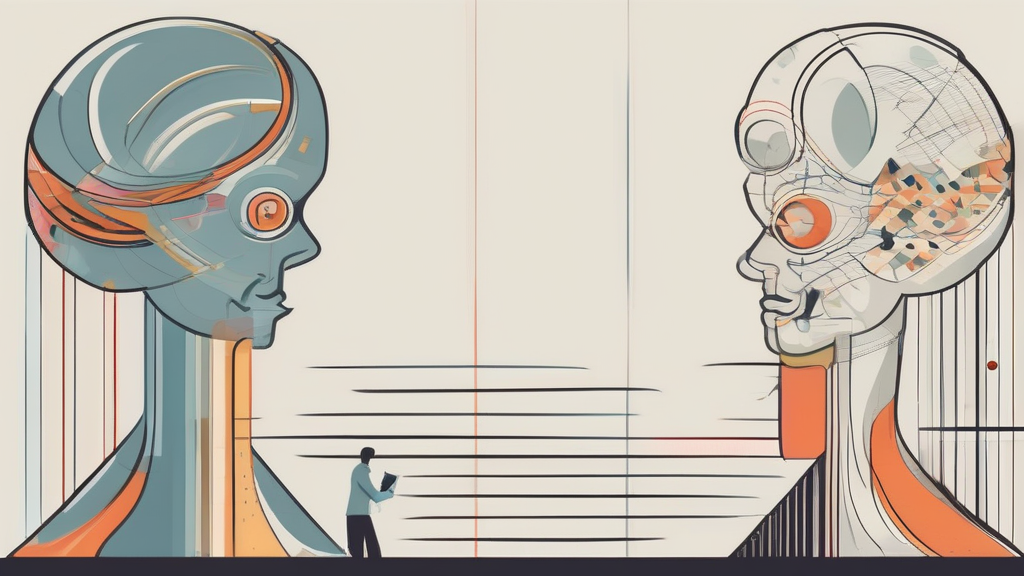
The Roots of Conversation: Meet ELIZA: The 1960s Computer Program That Became the World's First Chatbot
I remember the first time I saw a screenshot of a 1960s terminal. The green-on-black text looked primitive, almost alien. Yet, when I read the dialogue, I felt a strange sense of familiarity. It was Meet ELIZA: The 1960s Computer Program That Became the World's First Chatbot, a script that fooled people into thinking they were talking to a human therapist. It was simple, elegant, and—by today’s standards—incredibly limited.
Fast forward to the present, and we have LLMs that can write code, compose poetry, and debate philosophy. The jump from those early scripts to current generative models feels like magic. But is it really? Or is it just a massive scale-up of the same fundamental desire to bridge the gap between human language and machine logic?
How ELIZA Worked: The Illusion of Understanding
ELIZA wasn’t actually "thinking" in any sense we’d recognize today. It relied on pattern matching and substitution. If you typed "I am feeling sad," the program would scan for the keyword "sad" and trigger a pre-written response like, "Why are you feeling sad?"
It was a clever parlor trick. By reflecting the user's own words back to them, it created a Rogerian psychotherapy session. The program didn't need to understand the human condition; it only needed to understand the syntax of the input.
This approach is what we call rule-based logic. It’s a rigid system of "if this, then that." If the input matches a specific pattern, the script executes a specific output. If the input doesn't match anything, it defaults to a generic phrase like "Please go on."
The Limitations of 1960s Rule-Based Logic
The biggest hurdle for ELIZA was context. It had a memory span of exactly zero sentences. Every time you hit enter, the program treated it as a brand-new interaction. It couldn't track a conversation or remember what you said five minutes ago.
This is why it feels so "robotic" when you try to play with it today. It lacks world knowledge. It doesn't know what a cat is, what a city is, or why people get sad. It only knows that "I am [X]" should be met with "Why are you [X]?"
The Leap to Modern LLMs: Beyond Patterns
Modern Large Language Models, or LLMs, operate on a completely different level. Instead of hard-coded rules, they use neural networks trained on massive datasets. They aren't looking for a keyword match; they are predicting the probability of the next word in a sequence.
When you talk to ChatGPT, it isn't just echoing your words. It’s mapping the relationships between concepts. It knows that "Paris" is related to "France," "capital," and "Eiffel Tower" because it has processed billions of pages of text where those concepts appear together.
Why ChatGPT Feels Human
The secret sauce is the transformer architecture. It allows the model to pay attention to different parts of a sentence simultaneously, giving it a grasp of context that ELIZA could never achieve. It remembers the flow of the conversation, allowing it to maintain a persona or follow complex instructions over several pages of text.
Here is where the comparison gets interesting for business owners:
- ELIZA was a static tool. It did one thing and did it until it broke.
- ChatGPT is a dynamic engine. It can be a copywriter, a coder, a translator, or a research assistant.
- ELIZA required human programmers to write every single response variation.
- LLMs learn the rules of language and logic on their own through iterative training.
The Practical Reality for Your Business
Maybe you’re wondering why this history lesson matters for your bottom line. It matters because we are currently witnessing a shift in how we build software. We’ve moved from building rigid, rule-based systems to building flexible, probabilistic ones.
If you’re still relying on basic, rule-based chatbots for your customer service, you’re essentially using a modern-day version of ELIZA. Your customers can tell. They get frustrated when the bot doesn't understand their specific, nuanced problem because it wasn't pre-programmed into the decision tree.
Modern LLMs change the game by allowing for natural, fluid interactions. They can handle intent, not just keywords. A customer can say, "My order hasn't arrived and I'm getting worried," and a modern AI understands the emotional tone and the logistical issue simultaneously.
The Evolution of Language Interaction
There is a distinct difference between being "smart" and being "thorough." ELIZA was a genius at being simple. It was designed to show that computers could simulate conversation, and it succeeded brilliantly. It opened the door to the field of Natural Language Processing (NLP).
Today’s models are thorough. They have read almost everything on the internet. But they also come with new challenges, like hallucinations—where the model sounds perfectly confident while being completely wrong. ELIZA never hallucinated; it just ran out of rules.
This is a trade-off that business owners need to manage. Do you want the rigid, predictable safety of a rule-based system, or the creative, expansive, yet occasionally unpredictable power of an LLM? For most, the answer is a hybrid approach.
Choosing the Right Tool for the Job
You shouldn't throw away rule-based logic entirely. There are scenarios where you want a computer to be absolutely predictable. If you are handling sensitive banking information or medical triage, you probably want the strict guardrails of a rule-based system rather than the creative flair of a neural network.
However, for marketing, content creation, and customer engagement, the flexibility of LLMs is unmatched. They don't just respond; they engage. They can match your brand voice, adjust their tone, and provide information in a way that feels helpful rather than transactional.
Think about how you use these tools today. Are you using them to mimic human interaction, or are you using them to solve actual problems? The history of ELIZA reminds us that the goal has always been to make machines feel more accessible. We’ve just gotten much, much better at hiding the wires.
Looking Ahead: The Future of AI Conversations
We are currently in a period of rapid iteration. Every few months, a new model comes out that makes the previous one look like a relic. The path from ELIZA to current AI is a straight line of increasing complexity and decreasing human intervention in the "programming" phase.
What comes next? We are moving toward agents that don't just talk, but act. Imagine a chatbot that doesn't just tell you how to reset your password but actually performs the reset for you across your internal systems. That is the next frontier of this technology.
Whether you are a developer, an entrepreneur, or just a curious user, understanding this history provides context for the tools you use daily. You aren't just using a "smart" box; you are using the culmination of sixty years of research into how machines can mimic the most complex thing in the universe: human thought.
Stop settling for bots that feel like they were programmed in the 1960s. Start integrating LLMs that understand your business, your brand, and your customers. If you're ready to upgrade your customer experience or streamline your workflow with modern AI, start by identifying the repetitive tasks that are currently draining your team's time. The tech is ready—are you?
Thank you for reading my article carefully, thoroughly, and wisely. I hope you enjoyed it and that you are under the protection of Almighty God. Please leave a comment below.
Post a Comment for "ELIZA vs. Modern LLMs: Comparing 1960s Rule-Based Logic to ChatGPT"