The Friendship Between Charles Babbage and Ada Lovelace: A Creative Partnership
Welcome to my blog theaihistory.blogspot.com, a comprehensive journey chronicling the evolution of Artificial Intelligence, where we will delve into the definitive timeline of AI that has reshaped our technological landscape. History is not just about the distant past; it is the foundation of our future. Here, we will explore the fascinating milestones of machine intelligence, tracing its roots back to the theoretical brilliance of early algorithms and Alan Turing's groundbreaking concepts that first challenged humanity to ask whether machines could think. As we trace decades of historical breakthroughs, computing's dark ages, and glorious renaissance, we will uncover how those early mathematical dreams paved the way for today's complex neural networks. Join us as we delve into this rich historical tapestry, culminating in the transformative modern era of Generative AI, to truly understand how this revolutionary technology has evolved from mere ideas to systems redefining the world we live in. Happy reading..
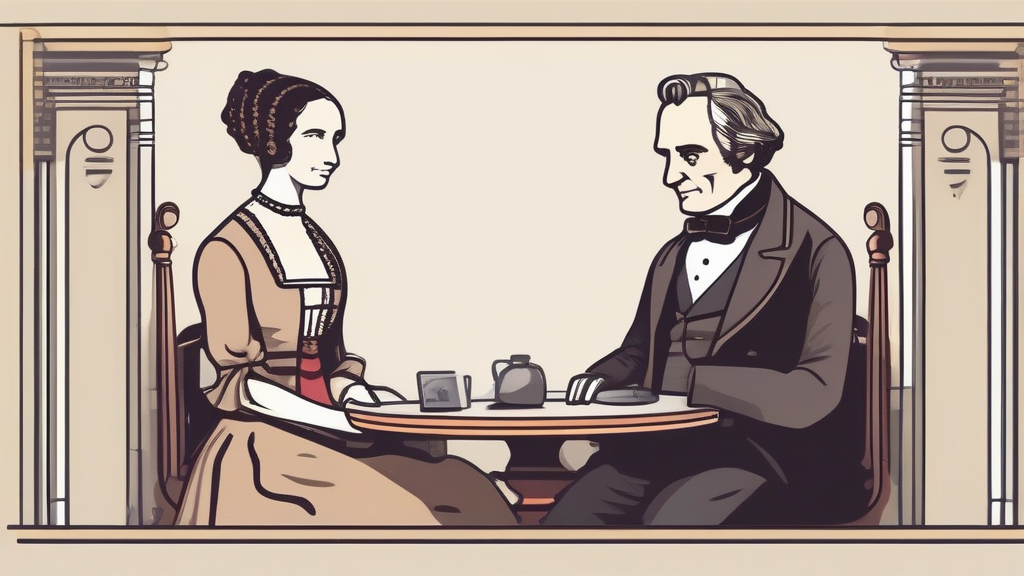
When I think about the origins of our modern digital world, my mind rarely drifts to the shiny glass-and-silicon reality of Silicon Valley. Instead, I find myself transported back to the smoky, brass-filled workshops of 19th-century London. It was an era of steam, gears, and radical intellectual ambition. Long Before Computers: Ada Lovelace and the 19th-Century Vision of AI, two brilliant minds were already sketching out the blueprint for the machines that would eventually run our lives.
The friendship between Charles Babbage and Ada Lovelace wasn't just a meeting of two high-IQ individuals. It was a collision of engineering grit and poetic imagination. While Babbage was obsessed with the mechanical precision of his machines, Lovelace was the one who saw the soul behind the gears. Together, they formed a creative partnership that feels surprisingly relevant to anyone working in technology or business today.
The Mechanical Mind of Charles Babbage
Charles Babbage was, by all accounts, a man who lived a few centuries ahead of his time. He was a mathematician, a philosopher, and a relentless tinkerer who couldn't stand the sight of human error in mathematical tables. He envisioned the Difference engine, a massive, complex calculator designed to automate the process of calculating polynomial functions.
But his ambition didn't stop there. He soon conceptualized the Analytical Engine, a device that was intended to be general-purpose. It was essentially a computer made of brass and steel, powered by steam, and capable of being programmed using punched cards. It was a massive undertaking that would have been the first of its kind, had it ever been fully constructed.
A Visionary Approach to Computation
Babbage’s struggle was one of funding and precision. He was constantly battling the British government for money, and the manufacturing technology of the era simply couldn't keep up with his requirements for accuracy. Imagine trying to build a modern smartphone using only hand-forged clockwork parts. That was Babbage's daily reality.
Despite these setbacks, he remained undeterred. He was convinced that if a machine could handle numbers, it could handle any symbol governed by rules. This was the seed of modern computation. He wasn't just building a calculator; he was building a logic engine.
Ada Lovelace: The Poetical Scientist
Then there was Augusta Ada King, Countess of Lovelace. If Babbage was the engineer, Ada was the visionary who could see the "poetical" potential of his work. She was the daughter of the famous poet Lord Byron, and she possessed a unique ability to bridge the gap between rigorous mathematics and creative intuition.
She famously referred to her approach as "poetical science." This wasn't just a catchy phrase. It meant that she viewed the world through a lens where imagination and logic were not enemies, but collaborators. When she looked at Babbage’s designs, she didn't just see gears and levers; she saw a system that could manipulate symbols beyond mere numbers.
Transcending the Numerical Limits
Ada’s breakthrough came when she translated an article about the Analytical Engine by Luigi Menabrea. She added her own extensive notes, which turned out to be far more significant than the original text. In these notes, she described how the engine could process music, graphics, or even complex logical arguments if they were coded correctly.
This is where the concept of Before Computers: Ada Lovelace and the 19th-Century Vision of AI really takes hold. She realized that if a machine could process symbols according to rules, it could potentially simulate processes that we associate with human intelligence. She was effectively outlining the logic of computer programming long before the hardware existed to run it.
A Creative Partnership for the Ages
The synergy between Babbage and Lovelace is a perfect case study for any modern creative or entrepreneur. They were an odd couple in many ways. Babbage was often prickly, impatient, and socially awkward, while Lovelace was sharp, insightful, and arguably more aware of the philosophical implications of their work.
They spent years writing letters, meeting in London drawing rooms, and debating the future of mathematics. Their correspondence shows a deep mutual respect, though it wasn't without its tensions. They pushed each other to think bigger. Babbage provided the technical constraints, and Lovelace provided the conceptual framework to break through them.
What We Can Learn from Their Collaboration
If you are running a business or working on a creative project, you can learn a lot from how they interacted. Their partnership succeeded because it combined two essential elements:
- Technical Mastery: You need someone who understands the "gears"—the actual mechanics of how your product or service works.
- Creative Foresight: You need someone who understands the "why" and can see the broader impact or potential applications of your work.
Many businesses fail because they have one without the other. You might have the best technical product, but if you don't have the "poetical" vision to explain why it matters to the world, it will remain just a collection of parts. Conversely, having a great vision without the technical discipline to execute it leads to vaporware.
The Early Seeds of Artificial Intelligence
When we talk about the history of AI, we often start with Alan Turing or the mid-20th-century pioneers. But the groundwork was laid much earlier. Ada Lovelace famously remarked that the Analytical Engine had no pretensions to originate anything; it could do whatever we knew how to order it to perform. This is often called "Lovelace’s Objection."
However, she also saw that the machine could be used to create music or art, provided the rules were set. She was essentially describing the concept of an algorithm. She understood that a machine is only as good as the instructions it is given, which is a foundational principle of modern machine learning and AI development.
The Victorian Vision vs. Modern Reality
It’s fascinating to compare their 19th-century vision with our current AI landscape. We are now living in the world they could only dream of. We have machines that can learn, adapt, and even surprise us. Yet, the core question remains: are these machines truly creative, or are they just following the incredibly complex instructions we’ve programmed into them?
Lovelace’s skepticism was healthy. She understood the boundary between human intent and machine execution. Today, we often blur those lines, but her insistence on the distinction between the machine’s output and human agency is still a critical topic in ethics and technology.
The Legacy of a Partnership
Babbage never finished his Analytical Engine. He died a frustrated man, feeling that his life's work had been misunderstood and underfunded. Ada Lovelace died young, at the age of 36, never seeing her notes come to fruition. From a strictly utilitarian perspective, you might call their project a failure.
But history tells a different story. Their legacy isn't found in the brass machines that never ran; it's found in the intellectual path they carved. They proved that technology is a human endeavor. It is driven by curiosity, tested by logic, and refined by imagination.
Why Their Story Matters Today
In a world where we are constantly chasing the next big software update, it’s worth pausing to appreciate the foundations. We are standing on the shoulders of people like Babbage and Lovelace. Their story is a reminder that the most significant innovations often start as conversations between people who are willing to think differently.
Whether you are a coder, an artist, or a business owner, their partnership offers a blueprint for success. It’s about finding a collaborator who challenges your perspective, and it’s about having the courage to dream about what is possible before the tools even exist to build it.
Applying the Babbage-Lovelace Model
So, how can you apply these lessons to your own work? It starts by acknowledging that no one is an island. You need a mix of the practical and the visionary. If you are a technical founder, go find a partner who is a storyteller. If you are a creative, find someone who can help you build the structure that will support your ideas.
Also, don't be afraid to document your process. Ada Lovelace’s notes are the only reason we truly understand the potential of the Analytical Engine today. Writing down your ideas, your strategies, and your vision is the best way to ensure that your work has a lasting impact, even if the initial project doesn't go exactly to plan.
Embracing the Visionary Mindset
The 19th-century vision of AI was not about robots taking over the world; it was about extending human capability. It was about creating tools that could free our minds from the drudgery of repetitive calculation so that we could focus on higher-order thinking. That is still the goal today.
If you feel like you're struggling to innovate, ask yourself if you're stuck in the weeds. Are you too focused on the "gears" of your business that you’ve lost sight of the "poetical" impact you want to make? Sometimes, you need to step back and look at your work through a different lens.
Looking Back to Move Forward
The story of Charles Babbage and Ada Lovelace is more than just a history lesson. It is a testament to the power of human collaboration. They saw a future that didn't exist yet, and they worked tirelessly to bring it into focus. They understood that while the technology might change, the human impulse to create and solve problems remains the same.
As we move forward, let’s keep that spirit alive. Let’s build tools that serve us, and let’s keep the creative vision at the heart of everything we do. Whether it's AI, automation, or just finding a better way to manage your daily workflow, remember the partnership that started it all. If they could envision the future with nothing more than steam and imagination, just think about what you can do with the tools at your disposal today.
If you're inspired by the way these two pioneers bridged the gap between science and art, start by identifying your own "Analytical Engine"—the core project or idea you're working on—and ask yourself who can help you see it differently. Don't wait for the perfect conditions to start; start now, and let your vision lead the way.
Thank you for reading my article carefully, thoroughly, and wisely. I hope you enjoyed it and that you are under the protection of Almighty God. Please leave a comment below.
Post a Comment for "The Friendship Between Charles Babbage and Ada Lovelace: A Creative Partnership"